Monday, January 10, 2011
I love the initiative. In order to go beyond the early adopters, real-life use cases must be proven to work. Such high profile testing is a good stepping stone to show just that and encourage adoption.
What I would like to see more however from the media is some explanations of the science behind. We have all somewhat accepted that electric cars will save us from global warming and our addiction to oil. But will it? Will our lifestyle be sustainable after we all buy an electric car?
Electric cars do solve one thing for sure: on-the-spot CO2 emissions. No more smelly streets, headaches in the traffic or smoggy city-centers. But where is the electricity used to charge the car come from? Is it produced sustainably? Here in self-acclaimed green Denmark, still 80% of electricity comes from burning coal or oil. Mining and burning fossil fuels to produce electricity to run our cars still increase concentrations of CO2 in our atmosphere with the consequences we know from the IPCC reports. So unless we take a larger perspective and solve the full cycle, we are only solving the most visible but unfortunately superficial part of the problem.
Furthermore, if we rate the electrical car solution against all sustainability principles, it is also important to recognize that 1) we still require more mining of natural resources and fossil fuels to actually produce the cars (eventually producing more waste) 2) batteries require that we extract rare metals like lithium and create compounds not naturally present in nature, eventually increasing concentrations in the biosphere of those metals and compounds as they find their way into nature as waste (with unknown consequences on life).
One solution at least, if we must create those cars and batteries, is keeping the metals and chemical compounds in closed loops. Recycle. Not satisfying our needs for mobility with such wasteful solution as the private car is of course ideal. Simply put, is it really that efficient to use a 2,496 lb (1,132 kg) device to move my humble 165 lb (75 kg) self?
I still believe that the private car is not a sustainable solution for transporting 7 billion people. Investing all this money into creating a real sustainable public transportation system would be more efficient.. and sustainable. What happened to all those electric tramways??!
All this being said, have a good trip, Brian, looking forward to hear how it goes!
Refs.
Four principles of sustainability
IPCC causes of climate change
Sunday, January 09, 2011

Green roofs are good for:
1) BIODIVERSITY - provide new semi-natural habitats for different birds and invertebrates
2) AIR POLLUTION MITIGATION - roofs with shrubs and grass have the largest impact on reducing the amounts of particulate matter, ozone nitrogen dioxide and sulphur dioxide during day time and in-leaf season
3) ENERGY EFFICIENCY FOR BUILDINGS - green roofs have delivered savings of about 25% in energy bills
4) STORM WATER MANAGEMENT - effective way of storing rainwater because of the plants and growing medium absorbing capacities
5) AESTHETIC - views of a natural setting reduce stress levels and decrease heart rate
6) USE OF RECYCLED MATERIALS - recycled materials such as crushed bricks are used for membranes and drainage mats; the growing media could contain also compost from recycled households, agricultural and horticultural waste
7) PROPERTY VALUES - proper design and planning since the early stages of a new building or in an existing building (retro-fitting) will be beneficial to the overall property value
See master thesis from CEU. See more pictures from Faroese green roofs
Monday, April 14, 2008
The root issue at stake here is really China's answer. How to encourage China and all other countries to engage constructively with their minorities? Obviously patriotic classes and muzzling of the press is the childish answer, and this is where China can really show whether it has reached the maturity level of a world actor - not just economically or militarily, but also in terms of mindset.
What is the big deal with China hosting the Olympics? This was approved some years ago and China's track record in human rights was already known then. Now that the Olympics were given to them, isn't it somewhat unfair to contest it? By the way America's track record of human rights is not exactly a beacon of humanity. Can we use the Olympics to stop pointing fingers at others and all take our responsibilities as countries and address together the real humanitarian problems we all face?
Sunday, March 30, 2008
The reader might see in this round-trip fallacy the unfairness of stereotypes - minorities in urban areas in the United States have suffered from the same confusion: even if most criminals come from their ethnic subgroup, most of their ethnic subgroup are not criminals, but they still suffer from discrimination by people who should know better.
"I never meant to say that the Conservatives are generally stupid. I meant to say that stupid people are generally Conservative," John Stuart Mill once complained...
(Excerpt from Nassim N. Taleb "The Black Swan". For more on presidential IQs: http://www.lovenstein.org/report/)
Saturday, March 29, 2008
If we start with the fact that we are all fundamentally both good and bad, and that we can all act good and bad, what matters is whether the bad is actually relevant. For the American public Eliot is now banned and bad so he agreed to resign - showing by the way that he himself believes in this simplistic way of judging. Same model with Jeremiah Wright (Obama's pastor): it took some rhetorics from Obama to go beyond the "scandal" (which was only about Wright stating the above somewhat obvious statements about 9/11 really) and touch the relevant ("challenging Americans' intelligence rather than insulting it" - see the Economist March 22nd "The trouble wih uncles").
Anyway where are we? Oh yes, that in the end I bet Americans are capable to put John McCain in power - they proved that well enough by reelecting Bush. McCain best strategy is to keep quiet and gain from the benefit of the doubt, while others struggle to painstakingly justify every corner of their thoughts. At least Obama has done so and continues to do so (do read his book). Unfortunately, massive American ego wont go away in a snap. Obama is too smart, sophisticated, self-critical and "leftish" to be elected. If he was, he would probably get shot (as one of my American friend put it). To officialize the odds, I went to betfair.com and place a 70% bet against Obama to win (2.34 odds). I hope to loose my money.
Monday, August 29, 2005
Why war?
Visiting the Freud museum in Vienna I found an open letter from Albert Einstein to Sigmund Freud dated 1932. Einstein's question to the specialist of the human mind was: "Is there any way of delivering mankind from the menace of war?". In his letter, Einstein suggests the "setting up, by international consent, of a legislative and judicial body to settle every conflict arising between nations" and concludes by this axiom: "The quest of international security involves the unconditional surrender by every nation, in a certain measure, of its liberty of action - its sovereignty that is to say - and it is clear beyond all doubt that no other road can lead to such security".
Freud analyses rightly that "Conflicts of interest between man and man are resolved, in principle, by the recourse to violence. It is the same in the animal kingdom, from which man cannot claim exclusion." He agrees with Eisntein "There is but one sure way of ending war and that is the establishment, by common consent, of a central control which shall have the last word in every conflict of interests. On the subject of warfare paving the way to peace, Freud - with history on his side - is categorical: "there can be no true cohesion between the parts that violence has welded".
But Freud continues "there is no likelihood of our being able to suppress humanity's aggressive tendencies. Musing on the atrocities recorded on history's page, we feel that the ideal motive has often served as a camouflage for the dust of destruction; sometimes, as with the cruelties of the Inquisition, it seems that, while the ideal motives occupied the foreground of consciousness, they drew their strength from the destructive instincts submerged in the unconscious. Both interpretationsare feasible."
Freud later concludes "The ideal conditions would obviously be found in a community where every man subordinated his instinctive life to the dictates of reason. Nothing less than this could bring about so thorough and so durable a union between men. But surely such a hope is utterly utopian, as things are. Meanwhile we may rest on the assurance that whatever makes for cultural development is working also against war."
"How long have we to wait before the rest of men turn pacifist?" A question for evolutionary biotechnologists..
Read the annotated full correspondance (or the internet original)

Wednesday, August 10, 2005
Sunday, August 07, 2005
From this history book account, replace Reagan by Bush and you have the consistently ineffective track record of right-wing governments.
Thursday, July 07, 2005
Mr Bush stood solemnly behind his close ally in the war on terrorism Mr Bush, looking severe, as Mr Blair pledged to defeat the terrorists. "We shall prevail and they shall not." (FT) Bush's speeches always begin by frightening the audience to death with terrorism and finishes triumphantly by rousing them to patriotic confidence in their country's future victory - his June 28 speech use the words terror and terrorism 33 times! (see Fisk's commentary)
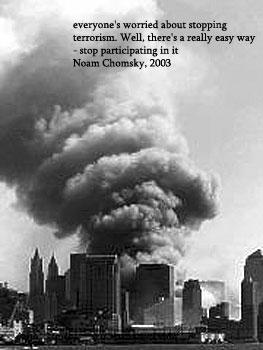
As long as we sanction arrogant and presumptuous attitudes from our leaders, rather than expecting them to address the root causes of terrorism, we can expect more violence. Ironically, it is true that the G8 agenda this time is one of the most humanitarian seen in a long time: African debt and global warming. But selling freedom with one hand and enslaving for petrol with the other will continue generating violence.
Solution: listen and address Bin Laden's concerns, which are not so unrealistic: "..neither America nor the people who live in it will dream of security before we live it in Palestine, and not before all the infidel armies leave the land of Muhammad". Make Palestine a reality; stop supporting authoritarian regimes of the Middle East for petrol. (full text) He concludes "Your security is in your own hands. And every state that doesn't play with our security has automatically guaranteed its own security." (full text)
On this, Denmark had its warning..
Wednesday, July 06, 2005
Terror and terrorism are loaded words which officials and newspapers often abuse. This polarizes and deceives people, undermining at the same time the credibility of the messenger and turning the message into propaganda. From both Politiken and the Copenhagen Post covering Bush's birthday visit to Copenhagen today: "4000 Danish police will be assigned to protect the president. The increased protection is the result of the threat of terror attacks." (City braces for Bush)
If the increased security is to protect "random targets of opportunity" in the civilian population, then the term "terror threat" is applicable. If the increased security is solely to protect the president - which is undoubtly the case - then it is an "assassination threat".
There is debate around the definition of "terrorism". Though Bush and some governments tend to lump together all resistance to established authority as "terrorism", there is a general concensus around the UN academic consensus definition: "Terrorism is an anxiety-inspiring method of repeated violent action, employed by (semi-) clandestine individual, group or state actors, for idiosyncratic, criminal or political reasons, whereby — in contrast to assassination — the direct targets of violence are not the main targets."
For a comprehensive definition and debate on terrorism, read on Wikipedia (Article:Talk) (This by the way is an online dictionnary editable by all. One can be surprised by the breath and quality of a global and open dictionary. If laws could be written so openly and democratically, the world would be a much fairer place..)
So, now that the world's number one terrorist is indeed one and in town, why demonstrate? The US military budget ($441.6 billion for 2006) represents more than half the discretionary US budget (the money the adminitration has control over and must decide to spend each year). The US spends almost as much as the rest of the world’s (totalling almost $1000 billion). It is an obvious waste and misuse of resources compared to: $6b for basic education for everyone in the world, $9b for water and sanitation, and the mere $10b all UN agencies and funds spend each year (more under the excellent Global Issues, article World Military Spending).

Preserving the 'Pax Americana' at the point of a unilateralist gun will only create more tension in the long run. It is a flawed and dangerous strategy (the full strategy at the New American Century (sigh).
Tuesday, May 31, 2005
How to define the EU and isolate its problems? Consolidating current treaties into a single foundation, clarifying the Union goals and values around humanism, reviewing EU institutions, streamlining decision-making and creating a foreign affairs ministry, is necessary for the new Europe of 25. To gain the legitimacy from "us, the people of Europe", establishing a constitution by consensus through referendum is both admirable and necessary. But it failed.
Europe is loosing its focus. The European dream is derailed, if not dead. The clear winner is the right-wing spectrum: extremists who are expectedly nationalists clinging to the dangerous concept of territorial nation-state, and the liberals, led by the U.K., who prefer an economic union without political union. The French socialists were courageous to voice their concerns: too centralized, too diluted, too market oriented, too long… But will we ever have a chance to get any better?
France, you fucked up.
It was surreal to watch the referendum results and the following debate this weekend in Brussels, while Grand-Mother was retelling her war stories - her fleeing to Bordeaux during the German occupation and Grand-Father being deported to work in East-German factories.. That was 50 years ago, are the dangers of nationalism already forgotten?
Solutions: 1. Visionary and courageous politicians that encourage and sell Europe, rather than use it as a cash cow or a scapegoat. 2. A new treaty to enable the most urgent and essential reforms needed for the Europe of 25 - much needed to give international weight to the EU and to insure a more secure and diverse multi-polar world, countering the dangerous American hegemony 3. A new, simplified and correctly scoped constitution for the people of Europe preceded by proper public debates and enacted by referendums.
Wednesday, May 18, 2005
"I don't think the United States would find it very comforting if China were to develop a death star, a 24/7 on-orbit weapon that could strike at targets on the ground anywhere in 90 minutes." Despite this obvious statement, history continues to be written today, as the US military confirms "space supremacy is our vision for the future" and aims to "expand the choices that we might be able to offer to the president in crisis". A safer world, the American way?
One Air Force program, neo-conveniently nicknamed "Rods From God", aims to "hurl cylinders of tungsten, titanium or uranium from the edge of space to destroy targets on the ground, striking with the force of a small nuclear weapon". Or how about "bouncing laser beams off mirrors hung from space satellites redirecting the lethal rays down to targets around the world"? Or let us be more reasonable and create a "military space plane carrying precision-guided weapons armed with a half-ton of munitions that can strike from halfway around the world in 45 minutes". (That'll teach 'em)
The new directive would replace a 1996 Clinton administration policy that emphasized a more pacific use of space. With little public debate, the Pentagon has already spent billions of dollars developing space weapons and preparing plans to deploy them. (Air Force Seeks Bush's Approval for Space Weapons Programs New York Times)
Solution? A global public debate and a UN resolution: space must be sanctified and no weapons ever put in space. Oh yes, and a continuing boycott on the US until it brings its 'defense' budget down to reasonable levels (now more than 50%) and submits fully to democratic principles and institutions on a global scale.
Monday, May 09, 2005
This is an attempt at stating the obvious and making the courageous conclusion that International English must be the common language of Europe.
The problem with Europe today is that it remains an intergovernmental organization of member states stuck in their monolingual narrowness: most states face the same economic and social problems, yet there is no collaboration on solutions due to language barriers. Insightful editorials by locally renowned intellectuals are of no value to the outside world because they are published in the local language only. Denmark has no clue what Germans are up to, whom really know nothing about how Danes deal with their own immigration or traffic issues.
There is a lot of potential for creating synergy between European countries. To enable this from grassroots level, Europeans need to embrace and encourage the teaching of a common language, spoken and understood by all. If this common language was chosen to be Esperanto, all governmental services and publications at all levels must be offered in Esperanto as well as local languages, all products must be labelled accordingly, all public spaces must be minimally bilingual, and most importantly all newspapers must publish in Esperanto as well as in their usual language of publication.
Outside Europe, since hardly anybody speaks Danish or German or Esperanto, the only view on Europe is through the British prism.. in English. However the UK is "frequently not in the mainstream of European thinking but rather the odd one out": the world was surprised that the EURO was successfully launched given the tone of the euro sceptic British media (See 'World has a distorted view of Europe').
This leaves only one option to improve both intra-Europe cross-communication and international communication: International English.
The problem with languages is that they represent both cultural identity and a mean to communicate. Europeans must embrace English as a mean to communicate, and their own mother tongue as a mean to express their unique identity. Which to use primarily depends on the audience, usually the public versus the private sphere.
Measures to 'protect' or encourage linguistic diversity are also necessary as long as they are linked to linguistic groups, not territorial space or historical antecedents, and that the measures are rooted in respect and understanding, not ethnocentricity (see the Universal Declaration of Linguistic Rights).
Under this, public spaces, product and services, and civil services would always be available in English, as well as in any other local languages; a local language being the language spoken by linguistic communities in a given area, independently of the Nation State tradition.
Thursday, March 24, 2005
Read the constitution and judge for yourself if it is truly a visionary and sound foundation for the values it claims to defend: "The Union is founded on the values of respect for human dignity, freedom, democracy, equality, the rule of law and respect for human rights, including the rights of persons belonging to minorities. These values are common to the Member States in a society in which pluralism, non-discrimination, tolerance, justice, solidarity and equality between women and men prevail."
This is more a 'statu-quo' document, a picture of Europe today, united in its diversity, rather than a true visionary and founding document. It lacks courage, but it is better than nothing; by making all parties from the political spectrum unhappy, it might prove to strike the right consensus. It is non-democratic however that freedom of residence does not give the right to vote in the country one lives and pays taxes. After 5 years in Denmark, I can only vote at municipal level and european level, not - and according to the constitution, never in the future - at national level. Why?
Whatever the conclusion, Denmark has already adopted provisions and exemptions, as it is typical for "Danes to believe Denmark is the best country in the world and that anything they do is better than anywhere else in the world" (Economic provisions, position of Denmark, acquisition of property in Denmark. Quote is from a Dane quite Danish-sceptic). How to convince normally socialist and cooperative Danes to expand their vision outside their little border?
Kyoto: in effect from February 16th, the protocol binds 37 industrialised countries to collectively reduce their greenhouse gas emissions (CO2, CH4, N2O, O3, CFCs) by 5% of the 1990 emission levels by 2012. A tough bet considering Canada now emits 20% more than in 1990, that Canadians emit as much as the whole of the African continent (30m versus 800m inhabitants!), more per capita than any other country! (Lisez le dossier complet sur Radio-Canada).
What to do? The federal government asks every canadian to contribute by reducing their gas emissions by 1ton each by 2010. At 2.5kg of emissions per litre of petrol burned, that means burning 250l less in the next 5 years, 50l less per year, just 2 small fill-ups less. At this pace, the planet will have ample time to warm up!
Scientits agree that taking measures today is far less costly than dealing with the environmental, health and economic consequences of climate change in the future. The climate is expected to warm by 0.5C every 10 year and the seas to raise 50cm by 2050.
Monday, February 28, 2005
Terrorism is wrong. It is wrong because it is not working and it is only destructive. Whatever the cause, indiscriminate killings can only alleniate potential supporters, jeopardising the success of the mission. For any work there are two approaches: the smart way or the botched way. Terrorist acts are botched: that is the revolutionaries have not done their homework.
For lack of communication, organization, cohesion, agreement on a common mission statement, and financial backing, terrorism only succeeds in creating a stalemate between insecurity and status quo, moving further into the future any potential positive change, leaving all parties on the defensive in the meantime.
The smart way is to play the chess game: settle and publish a clarified mission with detailed justifications, explore all potential solutions, create political arms to address the issues within the frame of the law, and create a more radical arm for those issues the current frame of law or order will not bulge on - the Ganghi-style civil disobedience.
As for terror acts themselves: a large bus killing can help drag attention to a cause, but it will never solve the problem, on the contrary. Radicals must target the strong pieces, the ones pulling the strings, people or infrastructure - without resorting to physical violence. Most importantly, like a game of chess, one must analyse the consequences of any action: who and what will come next and will that help the cause?
Terrorism in general is the result of cumulated frustration. Out of despair and feelings of powerlessness, one can be dragged into suicide or public vengeful acts, both extreme, destructive, egotistic, easy and useless acts. Feeling powerless and abused only happens when one did not have the chance to voice his opinion and participate in the decision-making process, when one - or one group - becomes the passive bearer of others' decisions. Promoting democracy within states is fine, as it should and will diminish tensions between different interest groups at the national level if decisions are given the time to reach a matured and unbiased consensus.
The problem remains wide open between states and with transnational interest groups. Hence the need for a global democracy.
Friday, November 12, 2004
Clinton concludes rightly "Most Americans don't live by rationality" (here)
Radio-Canada added: The American civil war ended, and it is the south and the southern values that won.
The FT questions what it means when those leaving the booths had "moral values" uppermost in their mind when they voted to return a born-again Christian to office. "As far as the Enlightenment programme of progress towards secular liberalism is concerned, the US has disengaged forward drive and shifted into reverse." (here)
Luckily, more cosmopolitan and less concerned with the brute exercise of power, Europe and Canada are actively "rebuking the vision of unlimited material progress, questionning market capitalism, state socialism as well as nation-state ideology", pioneering the development of a new vision based on "sustainable development, quality of life and multilateralism". (Read "The European Dream" by Jeremy Rifkin)
Monday, November 08, 2004
"The Corporation" sums it up best by pointing the finger at the flawed framework in our society: in the mid-1800s, the corporation succeeded to gain the status of a "legal person", but it has a personality of pure self interest. Its owners cannot be held responsible for the consequences of its transactions: illness, death, poverty, pollution or exploitation of society are "externals", or collateral damage if you prefer. Can water, a public good, really be sold for profit by a few private owners? Corporations have no social or moral responsability: did you know both Maersk and IBM sold to Hitler well into World War II? Making the corporation democratic can only be done by collective ownership. (Get it here).
Check out CPH:DOX, Copenhagen Documentary festival from Nov 5 to 14.
"Revolutionaries are never opportunists"


Non-violent Strategies and Methods